
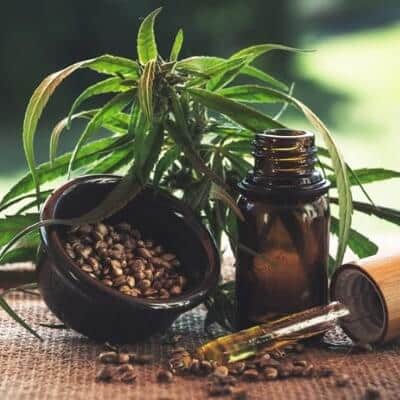
1. Growing hemp: an essential starting point
The quality of a CBD oil depends above all on the plant used.
Hemp grown in Europe comes from authorised varieties selected for their low THC content. The flowers are the part richest in cannabinoids.
Key factors :
- plant genetics
- growing conditions (outdoor, greenhouse, indoor)
- soil quality
- farming method
A high-quality raw material is essential to obtain a stable, homogenous extract.
2. Harvesting, drying and preparation
After harvesting, the plants go through a transformation phase called post-harvest.
Steps :
- Controlled drying (moisture reduction)
- refining (stabilisation of compounds)
- biomass grinding
This preparation optimises extraction by making the compounds more accessible.
️ 3. CBD extraction: a key stage in the process
Extraction involves isolating the cannabinoids and terpenes contained in the plant.
There are several methods, but they are not all the same.
Solvent extraction (old method)
Uses solvents such as :
- butane
- propane
- ethanol
How it works :
The solvent dissolves the compounds and is then evaporated.
Limits :
- not very selective extraction
- variable quality
- now less used for premium products
Extraction with supercritical CO₂
A method widely used in industry.
Principle :
The CO₂ is placed under pressure to become a supercritical fluid capable of extracting the compounds.
Advantages :
- no solvent residues
- high purity
- controllable process
Limits :
- high cost
- optimisation needed to preserve terpenes
️ Cryo-ethanol extraction: an advanced process
Le cryo-ethanol is a modern development of ethanol extraction.
Principle
The ethanol is cooled to a very low temperature (down to -40°C).
Why is this important?
Cold :
- waxes do not dissolve
- terpenes are better preserved
- cleaner extraction
Detailed cryo-ethanol process
1. Cooling the solvent
The ethanol is brought to negative temperature.
2. Contact with biomass
The solvent passes through the plant material.
3. Rapid extraction
The cannabinoids are dissolved without extracting too many impurities.
4. Cold filtration
Elimination of unwanted particles.
5. Solvent recovery
The ethanol is evaporated and recycled.
Why this method is interesting
- better preservation of the aromatic profile
- more selective extraction
- good return
- constant quality
Cryoethanol is now considered to be one of the world's leading top-of-the-range process, often used to produce rich, balanced oils.
4. Winterisation and purification
The crude extract still contains :
- waxes
- lipids
- chlorophyll
Winterisation :
- cooling
- filtration
- purification
The result is a cleaner, more stable extract.
5. Decarboxylation
Cannabinoids are naturally present in acid form (CBDA).
Decarboxylation consists of :
- heat the extract
- transform CBDA into CBD
This stage makes the product more stable and usable.
6. Formulation of CBD oil
The extract is mixed with a carrier oil:
- MCT (widely used)
- hempseed oil
- olive oil
Objectives:
- ease of use
- standardise concentrations
- improve stability
7. Difference between full spectrum and broad spectrum
Full spectrum
- contains all the compounds of hemp
- includes traces of THC in compliance
Nobilis: Full Spectrum CBD oils
Broad spectrum
- with no detectable THC
- preserves other cannabinoids
Nobilis Broad Spectrum CBD Oils
8. Quality control and analysis
Each oil must be tested:
- cannabinoid profile
- absence of contaminants
- regulatory compliance
These analyses guarantee the quality of the final product.
9. Packaging
The oil is packaged in bottles:
- tinted glass
- dosing pipette
- practical format
Recommended storage :
- away from light
- in a dry, temperate place
Conclusion
The production of CBD oil involves a series of precise technical steps. From the cultivation of the hemp to the final product, each phase influences the quality.
Extraction methods, in particular Supercritical CO₂ and the cryo-ethanol, play a central role in preserving hemp compounds.
Understanding these processes allows us to better appreciate the differences between the oils available on the market.
️ Compliance statement
The information presented in this article is for information purposes only. It constitutes neither a promise of effect nor medical advice.

 Français
  Español
  English (UK)